Got to serve as a panelist on Melissa Harris-Perry again, this time with host Joy-Ann Reid. Chatted about the zealotry of Republican state legislatures and other topics with Dorian Warren, Ari Berman, and Robert George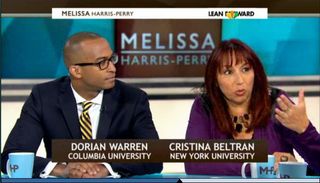 . Clips are here, here, here, here, and here.
The Trouble with Unity
NYU professor Cristina Beltrán's page for occasional updates
-
-
 Part of winning a Casa de las Americas Literary Award last year was the honor of having The Trouble with Unity translated into Spanish—and three copies of El problema de la unidad just arrived, direct from Havana!
 -
Had the pleasure of being a panelist again on Melissa Harris-Perry, this time with Ari Melber as guest host. Chatted with Raul Reyes, Jamal Simmons, and Matt Welch about the U.S. immigration bill and with Reyes, Jordan Goldberg, Salamishah Tillet, and Amy Hagstrom Miller about abortion-restriction legislation in Congress and state legislatures. Good times. (Also, at a couple of points, the screen showed my as-yet-barely-used Twitter handle [@CBeltranNYU] and my number of Followers more than doubled, so now I feel as though I need to start—what do you call it? Tweeting?)
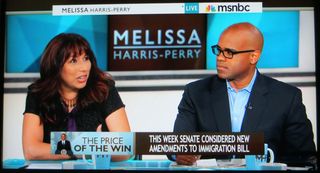
Links to the MHP segments on immigration are here, here, here, and here; those on reproductive rights are here and here.
-
My March 7 talk at UC Berkeley, "Undocumented, Unafraid, and Unapologetic: DREAM Activism and the Queering of Democratic Citizenship," is online here
 . The description: "Dr. Cristina Beltrán looks at how DREAM activists, particularly queer
DREAM activists, use forms of new social media as a space of
confrontation, creativity, and self-assertion. By working to queer the
immigrants rights movement, Dr. Beltrán argues that DREAMers are putting
forward more complex and 'gothic' form of political membership that
challenge the more traditional, xenophilic logic of immigrant rights
that emphasizes simplistic and problematic conceptions of patriotism,
legality, and loyalty." -
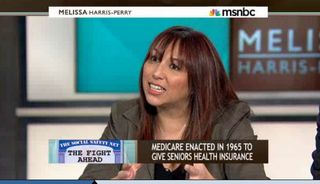
On Melissa Harris-Perry again this morning, with Seton Hall law professor Mark Alexander, Time writer Michael Crowley, and Columbia associate professor Dorian Warren. Got to chat about Chris Christie, entitlements, and presidential power. Some great discussions! The individual show segments are here, here, here, and here.
-
Some of my post-election thoughts went into an essay for NBC Latino. "…[R]ather than a monolithic cultural
community, Latinos are in fact a series of communities. At times these
populations display widespread agreement, as on Nov. 6. Support for
Obama in the 2012 presidential election is an excellent example of
Latinos expressing a shared political preference. But it hardly means
that Latinos constitute a singular or united political community with a
distinct policy agenda. Nor are they a
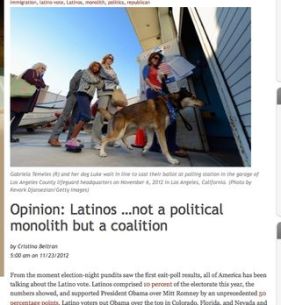 politically passive population, a 'sleeping giant'
that just happened to wake up on Election Day. Latinos are quite simply
part of America’s political community—current and future citizens with
ideas and opinions, an electorate that has finally reached a demographic
threshold at which their numbers allow them to impact the outcome of
state and federal elections." -
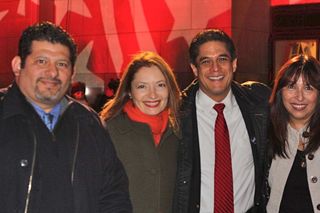
Had the pleasure of spending part of the evening of Nov. 6 with Sandra Lilley of NBCLatino, along with Stephen Nuño and Raul Reyes, discussing the Latino electorate. (Then went to a friend's apartment to watch state-by-state returns!) Video clip is here.
-
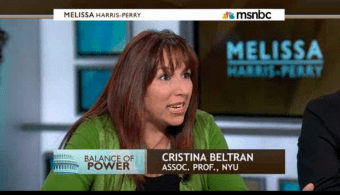 I was delighted to return to Melissa Harris-Perry October 20 to discuss Todd Akin, voter suppression, and other provocative topics. I'm on halfway through this segment and toward the end of this one.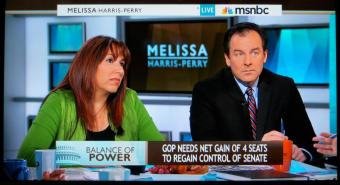
-
Quoted in Sandra Lilley's feature on Latino Catholics, based on a new survey from Pew Hispanic Center and Pew Forum on Religion and Public Life:
…“In the public imagination, people equate ‘Latino’ with ‘social
conservative,’ but these polls show that politically, thi
 s is not
necessarily the case,” says Cristina Beltrán, Associate Professor of Social and Cultural Analysis and Director of Latino Studies at New York University.…“What these polls show is that particularly for Latino Catholics,
there is nothing intrinsically ‘conservative’ about being a religious or
spiritual person and party politics,” says Beltrán.…“Latinos don’t tend to be animated by social issues like abortion and
gay marriage, but have been driven more around economic issues, or
Catholic teachings which stress social justice, like attention to
poverty,” explains Beltrán.…If the GOP wants to go after Latino voters, says Beltrán, their best
bet would be among Latino evangelicals. Even here, as Lugo points out,
Latinos are more divided about party affiliation.With Latinos now 11 percent of the electorate and rapidly growing,
“both parties have challenges, in terms of the changing configuration of
the electorate.” -
Two more journal reviews of The Trouble with Unity—both of them thoughtful and generous—have come to my attention:
In Latino Studies, U.C. Berkeley sociologist G. Cristina Mora calls the book "a must-read for all those interested in Latino Politics, Latino Identity and Political Theory." She continues: "In a context w
 here political parties are still trying to create images that peg all Latinos as either fundamentally conservative or profoundly liberal, Cristina Beltran's dictum to simply 'let Sleeping Giants lie' should be taken by activists, policy-makers and academics alike as an extremely insightful and valuable piece of advice."
 In Camino Real, political scientist José D. Villalobos of the University of Texas at El Paso writes: "In her new book, Dr. Cristina Beltrán challenges scholars to reconsider some of the most fundamental, longstanding assumptions about Latinos and their political behavior." He concludes: "In all, her words are refreshing, eye-opening, and sure to generate many lively debates and discussions among scholars."
 The Trouble with Unity