The Trouble with Unity

NYU professor Cristina Beltrán's page for occasional updates

  • Visited UCLA in late February for a work-in-progress workshop and presented a paper exploring "the resonances between AIDS activism and undocumented activism," which went extremely well: UCLA faculty and graduate students have always been extraordinarily helpful and supportive—sparking fruitful conversations, sending my thinking in fresh directions, clarifying my arguments, and helping me over rough patches and weak transitions.

    Several daysUCLA poster later, I discovered that a handful of right-wing opinion sites (no links necessary) had discovered the workshop and trumpeted it as an example of "perpetual grievance." A couple of sites that cultivate a Beavis and Butt-head sensibility sniggered at the use of the word queer, confident that their readers would sneer at the very mention of the existence of a professor from New York City.

    One blog labeled me an SJW, which I had to look up; apparently it means, pejoratively, social justice warrior rather than, as it used to, single Jewish woman. My paper—again, a rough draft—was very much an academic, theoretical work rather than an activist call to arms or a talking-points political screed, but if it's at all possible to reclaim SJW to mean, positively, social-justice warrior, at that point I'll take it!

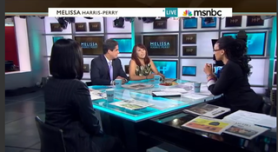
  • In the wake of the shooting of NYPD officers Wenjian Liu and Rafael Ramos, I got to join MSNBC's Melissa Harris-Perry and guest host Dorian Warren to discuss race relations. I'm in the segmentsC on MHP "How to move forward in the race conversation" (on at 1:35 and 8:15) and "What does future hold for ongoing protests?" (on at 2:35). 

  • In issue 32 of Walt Whitman Quarterly Review, Northwestern literature professor Betsy Erkkilä writes a comprehensive review of John Seery's A Political Companion to Walt Whitman, in which I have an essay on Whitman and Barack Obama, titled “Mestiza Politics: Walt Whitman, Barack Obama, and the Question of Union.”Betsy Erkkila on THE COMPANION copy

    Erkkilä writes: "Whereas in the past, Whitman’s politics would have been dismissed as irrelevant, hopelessly quaint, and even naïve, all of the theorists in Seery’s Political Companion approach Whitman as a poet actively engaged in the constitution of a democratic citizenry and community.… [A]s the first volume to bring together political theorists to reflect on Whitman as a political writer, A Political Companion to Walt Whitman provides a rich and compelling view of Whitman’s political insight and teaching, his shortcomings in relation to race, slavery, and women, and his enduring radicalism as a democratic visionary whoWWQR shared many of the concerns of contemporary political theory."


  • A few days before the midterm election, I got to spend the morning on Melissa Harris-Perry with fellow panelists Maya Harris, Katon Dawson, Kai Wright, Ian Haney-Lopez, and Jeff Chang. MHP copyThe segments: "Why Joni Ernst isn’t winning over Iowa women" (I speak at 3:30), "Scott Walker tries to woo women voters" (at 5:40), "Obama in ‘active stealth mode’ to reach black voters" (at 9:00), "Fight over American identity & the creation of culture" (at 4:00), and "Navigating the changing face of America" (at 3:50).

  • Out from NYU Press: Contemporary Latina/o Media: Production, Circulation, Politics, edited by Arlene Dávila and Yeidy Rivero. An essay of mine ("'No Papers, No Fear': DREAM Activism, New Social Media, and the Queering of Immigrant Rights") is included alongside work by a lot of terrific scholars on Latinos and the full range of media today. 9781479860586_Full

    Check out the anthology's introduction and table of contents here. The softcover edition is a mere $25!

  • In the middle of the Ferguson, Mo., crisis, Melissa Harris-Perry pulled together two this-is-happening-right-now shows, anMHPd I was on August 17, with Jelani Cobb, Marc Steiner, Marquez Claxton, and Khalil Gibran Muhammad. I'm in three segments: "This is 1961 in Ferguson" (I speak at 7:00), "The larger context of Michael Brown shooting" (at 2:50), and "What will future hold for race relations?" (at 3:45).

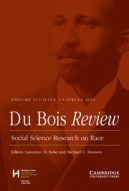
  • Very excited that the long-awaited Spring 2014 issue of the Du Bois Review, titled "Race in a 'Postracial' Epoch," is out; editors Robert Gooding-Williams and Charles W. Mills have compiled a terrific collection of new articles by Paul C. Taylor, Lawrie Balfour, Tommie Shelby, Kathryn T. Gines, Derrick DarDBRby and Argun Saatcioglu, Sally Haslanger, and Rory A. Kramer and Camille Z. Charles. My article "Racial Presence versus Racial Justice: The Affective Power of an Aesthetic Condition" lays out some of my current thinking on theory, race, and aesthetics: "While acknowledging that the presence of representatives from historically marginalized groups is a crucial component of justice, this essay argues for a new understanding of racial presence—not as proof that rScreen Shot 2014-07-28 at 8.00.52 AMacial justice has been achieved but as an aesthetically meaningful aspect of democratic politics characterized by multiplicitous interpretations and outcomes."   

  • Great to be back on Melissa Harris-Perry, this time with Raul Reyes and USC professor Jane Junn, co-author of The Politics of Belonging: Race, Public Opinion, and Immigration (winner of this year's APSA Ralph Bunche Award). Jane served on my dissertation committee at Rutgers long ago, so it was a pleasure to chat on and off the air! We discussed "the browning of America"; I was in the segments "The power JaneJunnof Latino voters" (I speak at 5:20), "Border Group_Shotcrisis sparks anxieties" (on at 4:30), and "Reframing the immigration crisis" (on, briefly, at 5:20).  
  • My first-ever guest-editing effort is in print! Ange-Marie Hancock and I edited a special issue of the WPSA journal Politics, Groups, and Identities, titled "Latino Politics and Political Theory: Rights, Power, and Membership," featuring original articles by P.J. Brendese, Juliet Hooker, Anna Sampaio, Paul Apostolidis and Abel Valenzuela Jr., Michael John Sullivan, and Edwina Barvosa, with a review essay by Sampaio and book reviews by Susan J. Carroll and Christina E. Bejarano. PGI back cover

    It was a great experience—and really nice to help promote work at the vibrant intersection of Latino politics and political theory.

  • In the new issue of Theory & Event, Whitman College professor Paul Apostolidis writes a generous, comprehensive review of The Trouble With Unity: "As a theoretical intervention, the book’s foremost contribution is to demonstrate how certain perspectives in democratic theory can open up unappreciated vistas on the politics of race and ethnicity in the United States, especially among Latinos. The Trouble with Unity thus makes Theory & Event review - art for website copya convincing case for the continuing abilities, in particular, of Wolin, Arendt, and Rousseau to speak to contemporary and recent democratic politics among people subjected to racial domination."